

/Discipline
/Profile
/See also
/Gender
/Life
Mathematician and professor, known for his proof of the prime number theorem (PNT). Born in Leuven on 14 August 1866 and died in Watermaal-Bosvoorde on 2 March 1962. Son of Charles Louis de la Vallée Poussin.
Biography
Born in Leuven on 14 August 1866, Charles-Jean de La Vallée Poussin grew up in a family of intellectuals. In reality, his father, Charles Louis de la Vallée Poussin, was a renowned geologist and professor at the University of Leuven. The family included several other eminent university professors, including Louis Philippe Gilbert, who had a strong influence on his young cousin's new orientation towards the mathematical sciences.
De La Vallée Poussin began his education at the Collège de la Sainte-Trinité in Leuven with the Josephite Brothers, before continuing at the Collège Saint-Stanislas in Mons, which was run by the Jesuits1. He joined the University of Leuven to study engineering for the Arts and Manufactures, Civil Engineering and Mining. Despite obtaining his degree in 1890, the passion for mathematics instilled in him by Louis Philippe Gilbert took over and led him to a doctorate in Physical Sciences and Mathematics under the guidance of his cousin and mentor. During this period, de La Vallée Poussin studied for a time in Paris with renowned mathematicians such as Camille Jordan, Charles Hermite, Gaston Darboux and Henri Poincaré. A year later, in 1891, he obtained his doctorate in physical sciences and mathematics.
In October of 1891, de La Vallée Poussin deputised for Louis-Philippe Gilbert for the mathematics course at the University of Leuven.2 After the untimely death of his cousin Gilbert in 1892, de La Vallée Poussin succeeded him in the chair of mathematics.3 He was promoted to extraordinary professor in 1893 and ordinary professor in 1897.4 He was also appointed to the chair of mathematics at the University of Leuven.
During this early period, de La Vallée Poussin's research focused on integrals and differential equations. His first publications had already attracted the attention of the Belgian scientific community, and more particularly of Paul Mansion. In fact, de La Vallée Poussin's early work was awarded a prize by the Académie royale des Sciences et Belles-Lettres in Brussels. In 1896, the demonstration of his prime number theorem brought him international renown.
On 19 April 1900, de La Vallée Poussin married Marie Caroline Frédérique Joséphine Dhanis,5 whom he had met on holiday in Norway and who "constantly kept the brambles and thorns out of my way"6.
In 1914, de La Vallée Poussin managed to leave Belgium safely with his family. His first port of call was the United States (1915), where he was invited to lecture at Harvard University and Cambridge University (Massachusetts). Like many scientists, he then travelled to Paris (1916), where he was warmly welcomed at both the Collège de France and the Sorbonne. De La Vallée Poussin gave a number of lectures and filled in for professors called up for military service. These lectures, given at Harvard University, the Collège de France, the Sorbonne and the University of Geneva, were followed by several monographs on the integration and approximation of functions, which have become classics.7 Around the common themes discussed in Paris, de La Vallée Poussin had forged a sincere friendship with the mathematicians Henri Lebesgue and Paul Montel.8
When the war was over, de La Vallée Poussin returned to Belgium to resume his work as a teacher. In the years following the end of the war, he travelled to several universities across Europe (Strasbourg, 1921; Madrid, 1923; Sorbonne, 1924 and 1925) and the United States (Chicago, Columbia, Berkeley, Wisconsin, Minnesota, Yale, Princeton, Rice Institute, Brown and Philadelphia).9 At Louvain, de La Vallée Poussin had Gustaaf Verriest as one of his students. He also supervised Georges Lemaître's thesis.10 Despite the vast scientific network of mathematicians, de La Vallée Poussin conducted his research in isolation. He did not found any school of mathematics at the University of Louvain, and had few students around him,11 Although he reached retirement age in 1936, he kept the mathematical analysis course at the University of Louvain until 1943.12 In the end, he taught for 60 years.7
De La Vallée Poussin was elected a corresponding member of the Académie royale des Sciences et Belles-Lettres de Bruxelles on 15 December 1898, then a member on 6 June 1908, he became President of the Class of sciences in 1923,13 serving in the Académie for no less than 64 years.7 As general secretary of the Société scientifique de Bruxelles, he contributed to its Annales, publishing several works14 including his prime number theorem15 At international level, he was also a member of the Instituto de Coïmbra, the Koninklijke Hollandsche Maatschappij der Wetenschappen in Haarlem, the Royal Scientific Societies of Utrecht and the Lower Rhine, the Mathematical Union of France and Spain, the Accademia Pontificale de' Nuovi Lincei, the Accademia nazionale dei Lincèi, the Real Academia de Ciencias Exactas, Físicas y Naturales in Madrid (1923), the Società Nazionale di Scienze, Lettere e Arti in Naples (1916) and the American Academy of Arts and Sciences in Boston. He was also made an associate member of the Institut de France. At the end of the First World War, the International Mathematical Union was created, and de La Vallée Poussin became its president and then honorary president.
His list of honours did not end there. In fact, he also received honorary doctorates from the Universities of Paris, Toronto, Strasbourg and Oslo.16 He was awarded the title of Grand Cordon of the Order of Leopold II and Commander of the Légion d'Honneur.17 De La Vallée Poussin also won numerous prizes, including twice the Decennial Prize of the Belgian Government for Pure Mathematics for the periods 1894 to 1903 and 1914 to 1923. In 1928, King Albert I made him a baron. Finally, at the Catholic University of Louvain (UCL), a La Vallée Poussin chair offers a mathematician the opportunity to teach there.18
Works
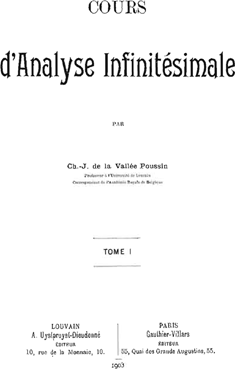
Title page of the Cours d'analyse infinitésimale, (1903).